We all know that India is diverse. We read the news, we watch debates on television, and we see fragments of society reflected back to us every day. Yet knowing of a country and truly seeing it are not the same.
When I was younger, I was deeply patriotic. Like many Indian children, I was raised in an education system that taught us to honour the nation, remember freedom fighters, and stand proudly during flag hoisting ceremonies. Cultural programs, patriotic songs, speeches, and movies filled our school years and national holidays. These rituals shaped us more than we realize.
In the middle of all this, we rarely paused to question what we were being taught.
I was so patriotic that I dreamed of joining the army. Even after graduating in nursing, I seriously considered Air Force nursing—anything that would allow me to serve my country. The idea alone gave me goosebumps. I worked toward it with sincerity, believing that service was the highest form of love for a nation.
But after graduation, when I stepped into the real world, the India I encountered felt very different from the one I had been taught to revere.
Maybe distance from school dulls patriotism. Or maybe it is prolonged exposure to a system that feels deeply corrupt and discriminatory. We are raised on textbooks, speeches, films, and music that awaken love for the country—but once you move beyond that protected space, pride becomes complicated. At times, it even becomes painful.
I have seen a country where citizens are forced to bribe government officials to receive basic services, as though public servants are not paid by the public itself. I have seen people weakened by poverty, entire communities excluded because of religion, women silenced by fear, and caste still determining who is “allowed” to touch whom.
I often ask myself: Where was this reality in our classrooms?
Why were we taught only pride, without truth?
Why was awareness replaced with celebration?
A retired judge, Gopal Gowda, speaking to The Hindu, noted that religion and caste continue to build walls between people, leading to the erosion of human and moral values. He pointed out that even after 75 years of independence, women still struggle for property rights and untouchability remains prevalent in many villages. He argued that only solidarity across faiths and genuine brotherhood can address these social wounds.
I did not leave the system because I lacked love for my country. I left because fighting it required time, courage, money, and safety—resources many victims simply do not have. People learn to survive around broken systems when confronting them feels impossible.
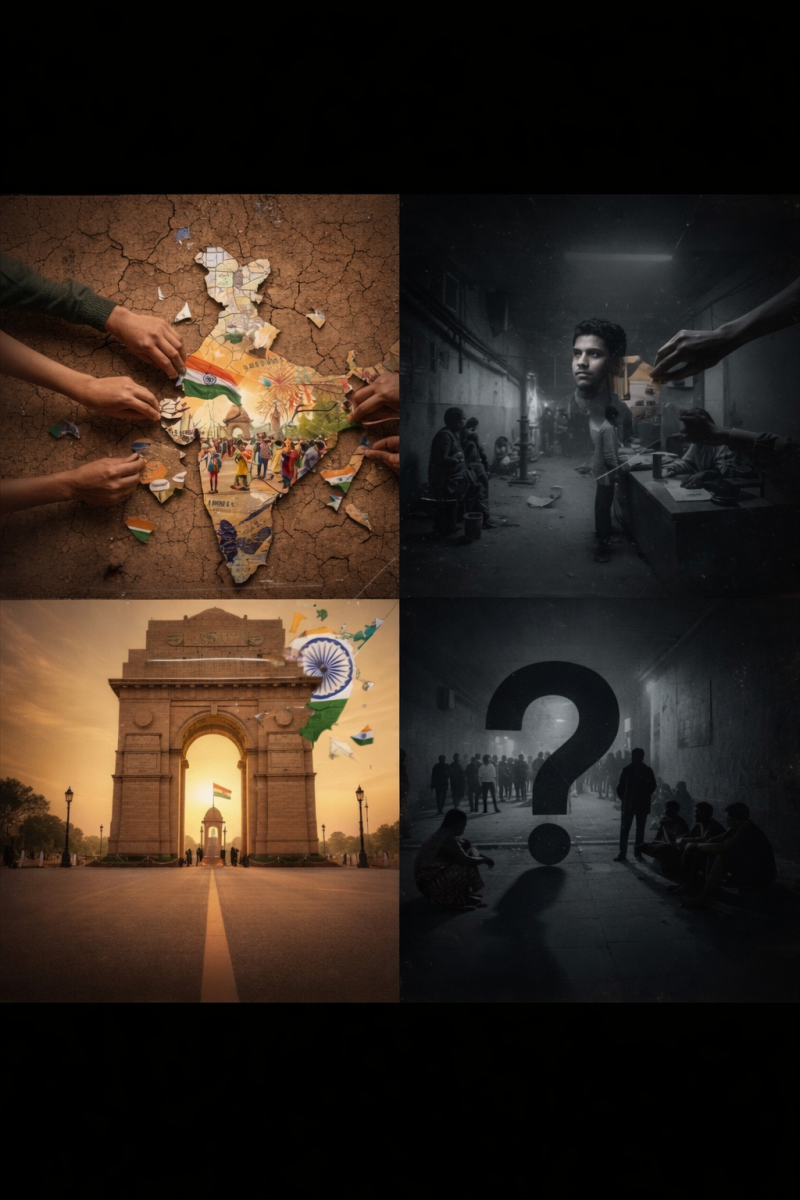
After coming to Canada, I found something else unsettling. In conversations with fellow Indians, when I shared my experiences, many did not believe me. They insisted such systems no longer exist. Some had been protected by money, by family, or by privilege—and what doesn’t touch you personally can feel unreal.
That is what hurts the most: that certain injustices do not exist to people living inside the same society.
Majorities and minorities, Christians, Hindus, Muslims—regardless of caste or belief, we are all citizens of India. Yet solidarity is rare. The poor are busy surviving day to day. The wealthy are busy protecting what they have. And between them, silence grows.
As reported by Human Rights Violations on the Rise in India,The New York Times, human rights experts have observed that while strong statements are often made at the highest levels of government, meaningful change rarely translates on the ground. There may be intention—but intention without action does not protect lives or dignity.
India is increasingly visible on the global stage. But visibility is not the same as progress. Just as immigrants carry their cultures—both good and flawed—across borders, India too is seen through both its strengths and its failures.
So the question remains: when the world looks at us, what will stand out more—our values, or our contradictions?
I still remember the words of the Indian Constitution we memorized in school: justice, liberty, equality, and fraternity. Today, it often feels as though these principles are selectively applied. Rules seem to bind citizens tightly while those in power remain untouched. When accountability flows only downward, governance begins to resemble hypocrisy.
This is where the younger generation stands confused. Many of them know the symbols—Republic Day parades, flags, slogans—but not the substance behind them. They were taught how to celebrate, but not how to question. They inherited rituals without being given the language to examine whether the Republic is living up to its promise.
So I ask, not out of disrespect but responsibility:
What does Republic Day truly mean today?
Is it remembrance—or is it reflection we are avoiding?
Until we are willing to look honestly at ourselves, celebration alone cannot hold a nation together.
Add comment
Comments